.png)
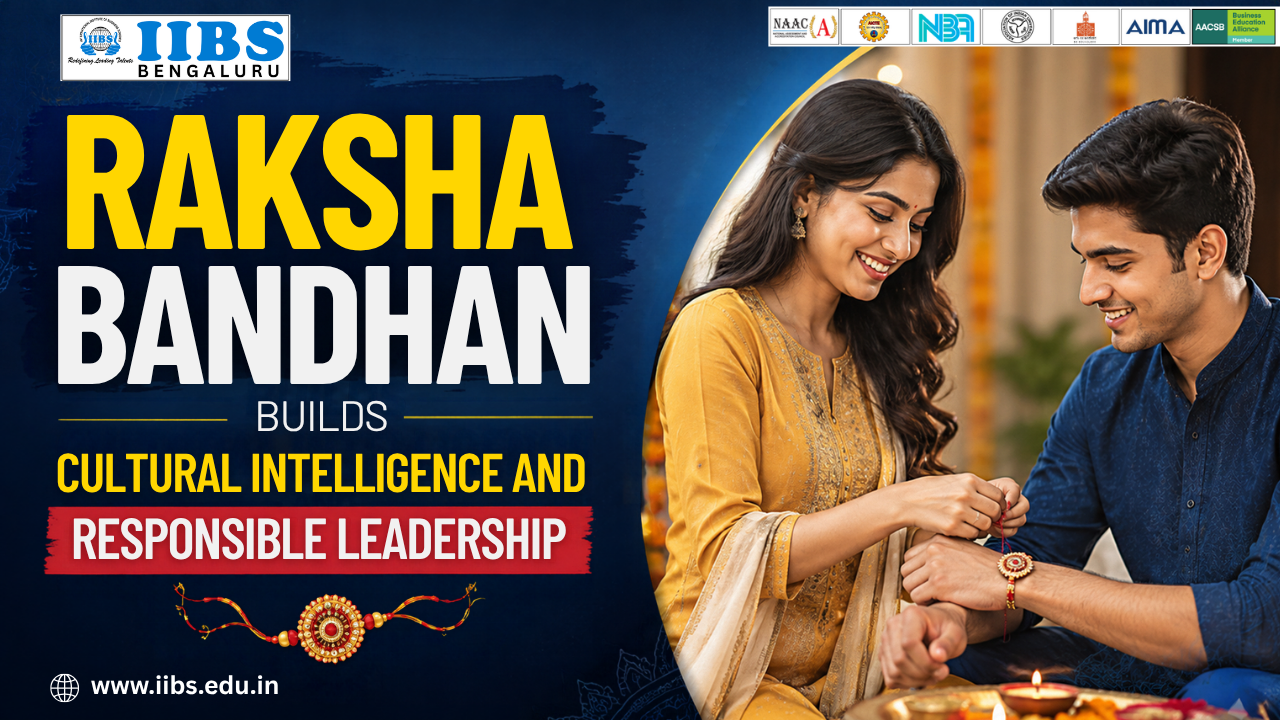
A rakhi carries love, trust, and a heartfelt promise to stand together. Raksha Bandhan celebrates the emotional bond between siblings and reminds us that every meaningful relationship needs care, respect, and responsibility. These values also form the foundation of responsible business leadership.
Leadership development for business graduates begins with understanding people. A successful leader respects cultural emotions, listens to different perspectives and protects the trust that employees, customers and stakeholders place in an organisation.
Cultural Intelligence Begins with Respect
Every employee, customer and business partner carries a cultural identity shaped by family, traditions, community and personal experiences. Cultural intelligence enables future managers to understand these identities, communicate respectfully and make decisions that connect with diverse audiences.
Raksha Bandhan holds deep emotional significance for millions of families. When a business builds a campaign around the festival, it accepts the responsibility of representing those emotions with sensitivity. The concept, language, setting, and visual presentation must reflect the cultural expectations of the audience while preserving the brand’s creative identity.
The GIVA Raksha Bandhan Campaign as a Business Lesson
The recent Raksha Bandhan advertisement by jewellery brand GIVA offers a relevant case study for business graduates. The 36-second campaign featured Bollywood actor Kriti Sanon celebrating the festival with family members and a pet dog while wearing a contemporary Indo-Western outfit.
A section of social media users criticised the advertisement, particularly the choice of clothing and its suitability for a festival-focused campaign. Some viewers also questioned the inclusion of a pet in the rakhi ritual. Others defended the campaign and argued that the true meaning of Raksha Bandhan lies in love, protection and emotional connection rather than clothing or conventional representations.
As the debate intensified, GIVA withdrew the advertisement and issued a public statement expressing respect for Indian culture, traditions and festivals. The brand explained that its intention was to extend the festival’s love and celebration to pets as members of the family. It also clarified that hurting public sentiment was never its intention. Reports confirmed that the campaign was withdrawn following the public response.
The controversy extended far beyond an outfit, a celebrity, or an advertisement. It revealed how differently people interpret culture, tradition, personal freedom, and family relationships. It also demonstrated how quickly public emotions can influence brand reputation and customer trust.
What Business Graduates Can Learn from the Campaign
The GIVA campaign offers several practical lessons for future managers. A creative idea must connect with the emotional meaning of the occasion. Audience research must examine cultural expectations before a campaign reaches the public. Brand teams must also consider how people from different age groups, regions, and communities may interpret the message.
The campaign shows that brand intention and public interpretation may produce different outcomes. GIVA intended to extend the promise of love and protection to members of a family, including pets. However, a section of the audience interpreted the visual presentation differently. This gap between intention and interpretation created the controversy.
Business graduates must study this gap carefully. Marketing responsibility continues after an advertisement is released. Public reaction becomes part of the campaign and directly influences its outcome. A responsible brand listens to its audience, responds clearly, accepts feedback, and takes timely action to protect customer relationships.
The incident also highlights the importance of crisis communication. Removing a campaign may reduce immediate criticism, but rebuilding trust requires transparency, empathy, and consistency. Future managers must learn to respond without dismissing public emotions or abandoning the original values of the brand.
IIBS Bangalore Develops Culturally Intelligent Leaders
The International Institute of Business Studies, IIBS Bangalore, holds UGC Autonomous status, is accredited with an ‘A’ Grade by NAAC and is affiliated with Bengaluru City University. Its PGDM programme is approved by the All India Council for Technical Education, accredited by the National Board of Accreditation and recognised by the Association of Indian Universities as equivalent to an MBA. These credentials reflect the institute’s commitment to academic quality, professional relevance and industry-oriented management education.
At IIBS Bangalore, leadership education includes the ability to understand people, respect cultural values and make responsible decisions. Students learn that business success depends on professional knowledge as well as empathy, awareness and trust.
Experiential Learning Turns the Campaign into a Practical Case
The experiential-learning approach at IIBS Bangalore connects classroom concepts with current business situations. Live projects, case studies, internships, business simulations, corporate interactions and team assignments prepare students to examine customer behaviour, public sentiment and brand decisions.
Cultural celebrations, student-led events and campus fests provide another important learning platform. Students from different regions and communities work together to plan activities, communicate cultural meanings, manage audiences and create inclusive experiences. These opportunities transform cultural intelligence from a classroom concept into a practical leadership skill.
Through discussions of campaigns such as GIVA’s Raksha Bandhan advertisement, students learn to ask essential questions:
- Does the campaign respect the emotions connected with the festival?
- Does its visual presentation support the intended message?
- How might different customer groups interpret the content?
- Has the brand considered cultural and regional sensitivities?
- Is the organisation prepared to respond responsibly to criticism?
- Will the campaign strengthen or weaken public trust?
The rakhi eventually leaves the wrist, but its promise remains in the heart. That promise offers every future business leader a timeless direction to honour culture, understand people, protect trust, and lead with humanity.
See Also:
- MBA Graduate Placements Lead to Higher Salaries Than Engineering Placements
- IIBS B-School Competitive Edge in MBA Education Over Universities
- 50 percent MBA Scholarship at IIBS Bengaluru for Karnataka PGCET 2026 Students
- Why Karnataka PGCET Qualifiers Prioritise IIBS Bengaluru for MBA Excellence
- Independence to Innovation and the Role of Business Leadership in Building Viksit Bharat
- Best Private Business Schools for MBA in Bangalore with Strong Placements
- A Preferred MBA College in Bangalore Apart from IIM for Academic Excellence
- Karnataka PGCET Qualified? Counselling Tips for Your Dream MBA
- 5-Year Integrated Undergraduate-MBA Dual Specialisations Programme